
Agroforestry systems bring nature conservation and environmental protection to the cultivated landscape if WE manage to establish these crops on farms. This was the topic of discussion on 1st December 2025 at the Hanover Chamber of Agriculture: DeFAF e.V. (MODEMA project) and 3N Kompetenzzentrum Niedersachsen e.V. jointly organised the conference ‘Agroforestry systems as production-integrated compensation (Agroforstsysteme als produktionsintegrierte Kompensation, PIK)’. WE were 78 extremely lively participants from regional nature conservation authorities, consulting, research, companies, farmers, environment and agriculture ministries and associations. It was clear to everyone that this can only succeed if WE focus on an understanding of cultivated landscape development that offers space for nature and climate protection in agroforestry systems. The connection between agricultural production and nature conservation dates back to the 1980s. Prof. Dr. Wolfgang Schumacher secured habitats for valuable crop wild herb communities (segetal flora) in the cultivated landscape with the buffer strip programme in North Rhine-Westphalia (Schumacher 1980).
Forty-five years later, WE have the great opportunity to use agroforestry systems in open farmland to create extremely diverse habitats that can meet the qualitative requirements of applied nature conservation and environmental protection and, above all, can contribute significantly to compensating for human intervention in arable landscapes that have been neglected by nature conservation efforts. In fact, it is precisely in Germany’s arable landscapes that most interventions due to construction measures take place.
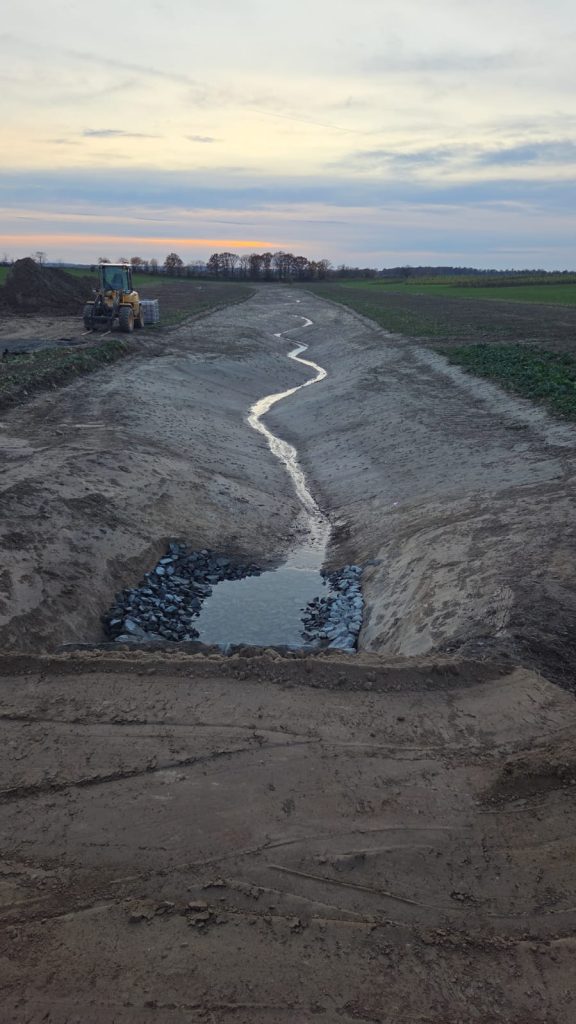
Frank Wagener (Institute for Applied Material Flow Management, IfaS – Trier University of Applied Sciences) presented in Hanover the example of the Tauchnitzgraben from AGROfloW. In this project, agroforestry systems are being used in the renaturation of a stream in such a way that they become part of a new renaturation concept and significantly enhance the value of the arable land. The IfaS has been working on production-integrated nature conservation since the ELKE project. In times of rapidly advancing climate change, the associated migration of entire biotic communities and ongoing biodiversity loss, we need new functional practical tools in nature conservation in order to be able to work more effectively with agriculture across the board. The design and integration of agroforestry systems across farms in our cultivated landscapes may offer the greatest opportunity in the last 50 years to return to sensible biocultural co-evolution.
Let’s seize this opportunity together: if you as stakeholder would like to get involved, please send a short email with the subject line “PIK stakeholder” to pr[at]defaf.de
Literature: Schumacher, W. 1980. Schutz und Erhaltung gefährdeter Ackerwildkräuter durch Integration von landwirtschaftlicher Nutzung und Naturschutz. Natur und Landschaft 55:447–453.