
The results of the Wood-Pasture Project are now available in the final report. The German Federal Environmental Foundation (Deutsche Bundesstiftung Umwelt, DBU) funded this first comprehensive biocultural assessment of wood-pastures in Europe (reference number 37480; project duration: 01 January 2022 – 30 June 2025). Two working groups from Babeș-Bolyai University and IfaS, involving up to 24 colleagues, addressed a broad range of research questions and synthesized their findings in peer-reviewed publications and in this final report.
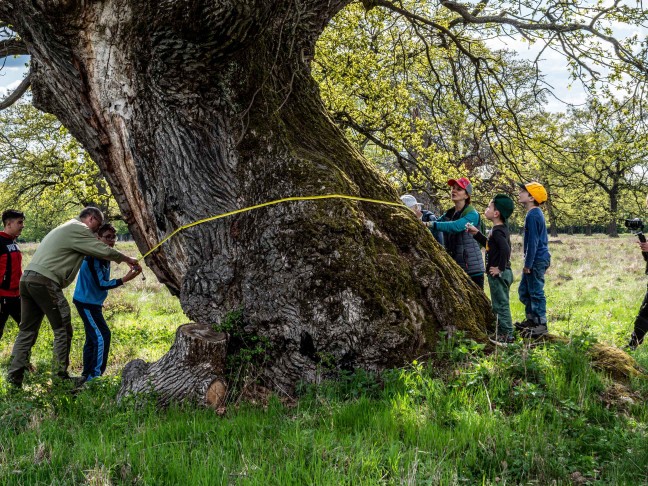
What the project documented: rapid transformation and shifting baselines
The Romanian project leader, Prof. Dr. Tibor Hartel, and the scientific advisory board member, Prof. Dr. László Rákosy, together with their working groups, contributed knowledge of Transylvanian wood-pastures accumulated since the mid-2000s, knowledge of inestimable value for this project and for future initiatives. This long-term perspective made one particularly important aspect visible: during 2022-2025 we were able to capture the amplification of the transformation of Transylvanian wood-pastures from a traditional to a modern cultural landscape.
Earlier studies were conducted at a time when there were no major socioeconomic or cultural changes affecting agriculture, and grazing systems in particular. As a result, several iconic features of wood-pastures, such as the presence of large (ancient) trees, the relative absence of fences, scattered shrubs and rich wildlife (including bears), were considered entirely normal in the ancient wood-pastures. So normal, in fact, that it was hard to imagine these features disappearing or changing dramatically within just a few years.
That is exactly what happened between 2022 and 2025: within a short period, we experienced profound changes. These changes are so significant that they are difficult to fully comprehend or document. Based on these observations, we must assume that by 2030 many Transylvanian wood-pastures will have lost key elements of their traditional appearance (physiognomy) as well as important ecological and social functions at the landscape scale. Even more alarming is the effect of shifting baseline syndrome: by 2030, many people will likely no longer remember what these wood-pastures once looked like, either in the more distant or even in the recent past.
Key results in numbers
- Consortium and capacity: 2 academic institutions, up to 24 colleagues from Germany and Romania
- Peer-reviewed outputs: 8 scientific papers published in journals including Scientific Reports, Conservation Science and Practice, Applied Vegetation Science, Trends in Ecology and Evolution, Journal of Biogeography, Ecosystems and People, Frontiers in Environmental Sciences, and People and Nature; plus 1 additional manuscript currently in review at Ecology and Society. Together, these publications advance biocultural research on wood-pastures by integrating ecological, cultural, and governance perspectives.
- Ecological and biocultural evidence base: an extensive survey of 110 wood-pastures, including their biocultural characterization
- Social research and community engagement: 32 semi-structured interviews and focus groups with 55 participants across 16 localities in Transylvania, plus 3 community-level activities; approximately 167 individuals reached in total (combined participation across interviews/focus groups and community events)
- Policy influence: contribution to Law 97/2023 for the protection of Remarkable Trees (including large old trees), and a project team contribution to the Romanian Forestry Code (2024)
- Youth and training: 3 Master’s theses completed within the project (Romania, Germany, Switzerland)
- European dissemination: presentation at the international LIFE Platform Meeting on forest restoration in Europe (Brașov, June 2025) to 90 participants from 17 EU member states, the United Kingdom, and Serbia, representing 38 LIFE projects plus relevant Horizon and Interreg initiatives
- Public outreach: project YouTube channel with 24 videos, produced from a pool of 76 visited sites and filmed interviews
Why wood-pastures matter and why action is urgent
Precisely because research on the biodiversity of wood-pastures has only recently intensified, it is essential to preserve Romania’s wood-pastures as a green cultural heritage of outstanding European importance for future generations. Studies consistently highlight their high biodiversity value, distinct animal and plant communities compared to other land-use types (e.g. open pasture, closed forest), the role of old trees as biodiversity hotspots, and the presence of rare and protected species and habitats. Wood-pastures are extremely species-rich, culturally enriching, and irreplaceable in Europe.
Throughout the project, we deliberately involved young scientists and students from Romania and Germany in our work. This approach enriched the project by incorporating “young perspectives” and by allowing us to observe how young people, equipped with knowledge about wood-pastures, developed their own ideas and became practically active, both in planting activities and in field biology. The aim is not to lament decline, but to identify solutions for the biocultural transformation of wood-pastures into the future.
Final report (only German)