AFaktive is organised in nine “work packages”, WPs (see figure below).
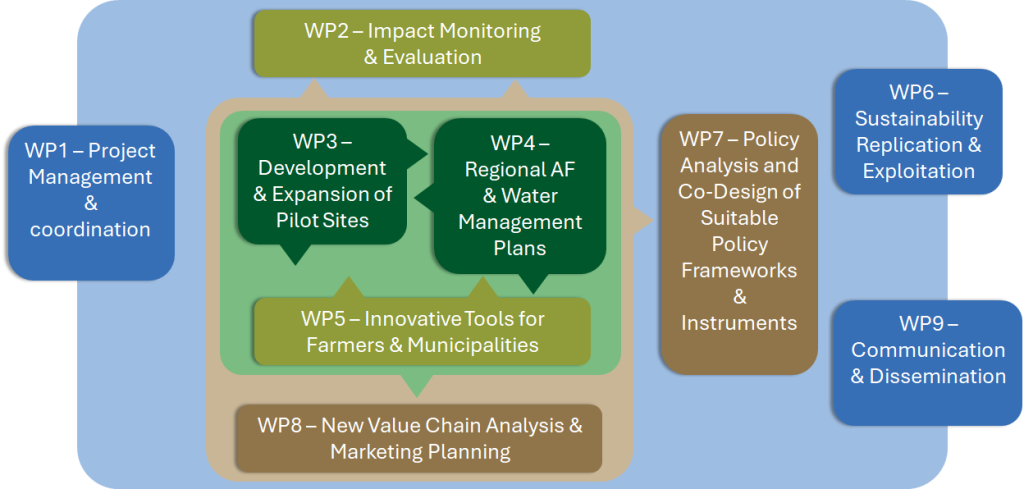
WP1 “Project management and coordination”, and WP9 ”Communication and dissemination of project results” are the framework of the project.
WP3 “Development & expansion of pilot sites” and WP4 “Regional Agroforestry and Water Management plans (R-AWM)” are the core of the project implementation (dark green in the figure).
- WP3 focuses on implementation at farm level. The aim is to establish pilot sites in order to increase the visibility of agroforestry as a tool for water management, gain practical experience, create platforms for exchange between practitioners and starting points for regional upscaling.
- WP4 focuses on the upscaling of agroforestry as a tool for improved water management at regional level (i.e. multiple farms, municipal level, whole watershed or district/province).
WP2 “Impact monitoring and evaluation” does not only monitor the results and impacts of the project, but also the agroforestry sites, with a special focus on hydrological measurements (s. article on field data). Furthermore, biodiversity, carbon and yield as well as socio-economic aspects are being monitored.
WP5 “Innovative tools for farmers & municipalities” is strictly linked to WP2 and aims at the development testing and application of new tools for an integrated agroforestry and water management. The data from telemetry and manual measurements collected in WP2 flows into the modelling and run-off simulation of pilot areas to estimate the influence of agroforestry on flooding, erosion, and soil moisture based on long-term in-situ measurements and monitoring (s. article “Why agroforestry is hard to simulate”).
W6 “Sustainability, replication, and exploitation of project results” aims to ensure the sustainability of the project, i.e. transferring key findings and experiences from AFaktive to relevant stakeholders ranging from farmers, consultants and planners to municipalities and (water) authorities. This serves the upscaling and replication of the project as well as a broader implementation of the results beyond the project scope and duration.
WP7 “Policy analysis and co-design of suitable policy frameworks and instruments to support agroforestry and water management approaches at local, national and EU level” aims to analyse the current framework conditions to facilitate the implementation processes within AFaktive as well as to identify the legal hurdles and barriers for the broader implementation of agroforestry as a water management tool. The results are available in the following article: Agroforestry-water nexus: a missed opportunity in policies?. This WP entails not only recommendations for policymakers, but also the development of regional case studies (link to WP4 “Regional Agroforestry and Water Management plans”) within a bottom-up approach.
WP8 “New value chain analysis and marketing planning” aims to assist pilot farms with the marketing of their selected products & services from agroforestry with integrated water management. The profitability of an agroforestry system is the prerequisite for the broad adoption and upscaling of this land use practice (beyond the pioneer scene of agroecology enthusiasts). The focus on this aspect in AFaktive underscores the project´s practice- and practitioner-oriented approach.