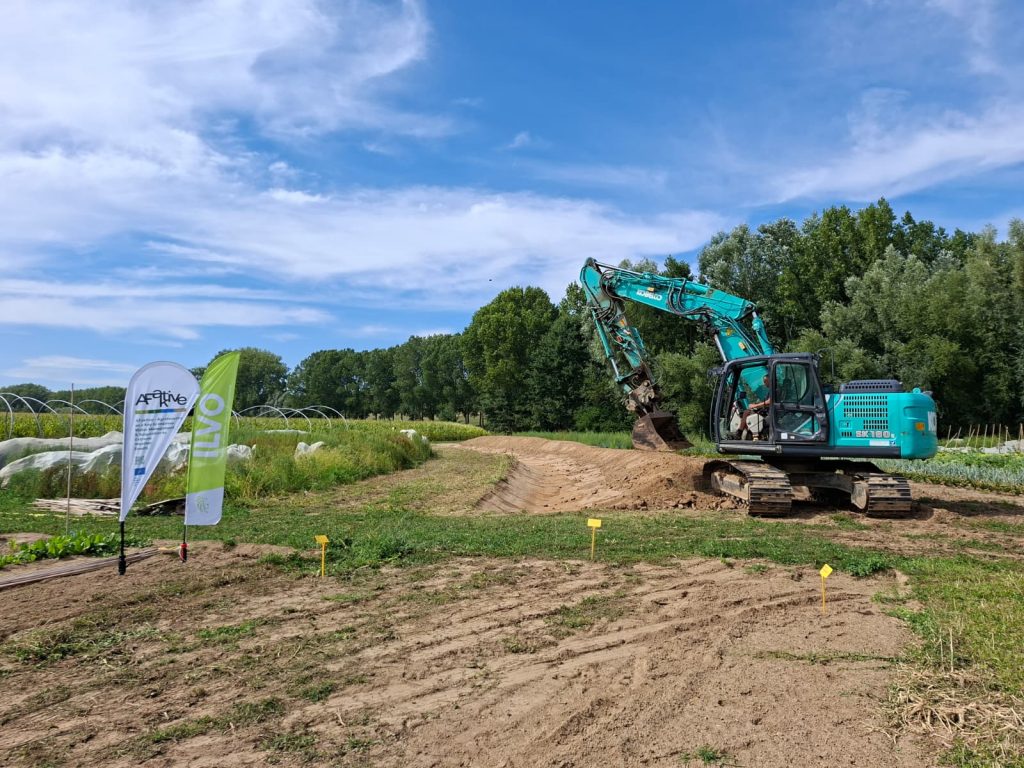
At the end of August, the AFaktive cooperative farm Pomona Puur Aerde in Flanders (Belgium) installed a swale – a shallow wide channel covered in vegetation – as a measure to boost the farm´s resilience to the challenges of both drought and heavy rainfall.
The swale was developed in collaboration with AFaktive partner ILVO (Flanders Research Institute for Agriculture, Fisheries and Food) and the Belgian regional landscape organisation Regionale Landschap Vlaamse Ardennen tot Dender, with support from local water authority Waterlandschap Zwalmvallei.
At the Pomona Puur Aerde farm, not only the impact on water management is being investigated, but also the possibilities of planting productive trees, small fruit and herbs along the roadside. For organic farmer Stéphanie De Caluwé, an improved water management is not a luxury – the very dry summer of 2026 had a clear impact on her business and claimed part of her harvest.
Swales are nature-based solutions that capture rainwater runoff and allow it to infiltrate into the soil and do so more slowly, which, in turn, helps mitigate the impacts of drought, flooding, and soil erosion. In fact, swales help retain water in the fields for longer and provide some advantages compared with traditional water reservoirs. While water stored in a reservoir must be actively pumped for use, a swale lets rainwater infiltrate the soil naturally, making it available to crops for an extended time. This process also helps to prevent the soil from drying out during prolonged dry spells.
Furthermore, farmer De Caluwé also anticipates benefits during wetter periods. The system captures runoff higher up the slope and gradually allows water to infiltrate across a larger area. As a result, she hopes the wettest parts of her fields will remain waterlogged for a shorter duration during winter. This could make the land accessible earlier in the season, enabling farm operations to begin sooner in spring.
Finally, installing a swale does not have to compromise productivity. The berm will be planted with soft fruits, rhubarb, and fruit trees, while the ditch will be perfect for moisture-loving herbs like mint. This way, the swale serves multiple functions: it retains water, provides a productive harvest, and creates additional habitat for plants and wildlife.
Through monitoring, field experiments, and knowledge sharing, the AFaktive LIFE project continues to assess and document the impacts of these nature-based water management systems and how they can be used on different types of farms.
The topic of swales is not new, especially in Flanders, where pioneer Rik Delhaye started experimenting with this type of approach already ten years ago. However, considering that the effects of climate change are becoming increasingly evident, especially on a summer like this year, there is a mounting interest in this type of systems.
In fact, the installation of the swale at the Pomona Puur Aerde farm was reported by three Flemish news channels, VRT NWS, VILT and Nieuwsblad.
Read the original article and get more information on swales on the ILVO website: link (Dutch).